
Major & Minor chords can be altered by simply raising or reducing the 5th note at the top and as a result they will have a new name entirely.
A Diminished Triad is a minor chord with a reduced 5th (by a half step)
Formula: Root + minor 3rd + flat 5
For instance, D minor triad DFA can be Diminished DFAb (the “A” note has been altered to a Diminished 5th or reduced 5th by a half step)
An augmented triad on the other hand is a Major Triad with a Raised 5th by a half step.
Formula: Root + Major 3rd + sharp 5
Example: C Major Triad “CEG” becomes C Augmented Triad CEG# (The initial “G” note has been altered to an Augmented 5th or raised 5th by a half step)
What is the Chord on the 7th degree of a Diatonic Scale?
We have 7 unique chord positions on a diatonic scale
Recall, we have the Primary Chords (1, 4 & 5 chord) and Secondary Chords (2,3 & 6 chord).
Have ever asked what will the chord on 7th degree is? What it sounded like?
It actually a Diminished Triad.
Have a quick look at the C Diatonic Scale
C D E F G A B C
1 2 3 4 5 6 7
B Diminished Triad (BDF) will be the Chord on the 7th Degree of the C Major Scale. Be aware that the 7 chord is also a Secondary Chord (since it’s just an altered minor chord)
The “1 chord” has a strong pull/affinity to resolve to the “1 chord”.
Play : B dim (BDF) and hear how it is yearning to resolve to the C Major Chord (CEG) and once you play the C Major Chord; there is a satisfaction that comes with it (You are resting at home).
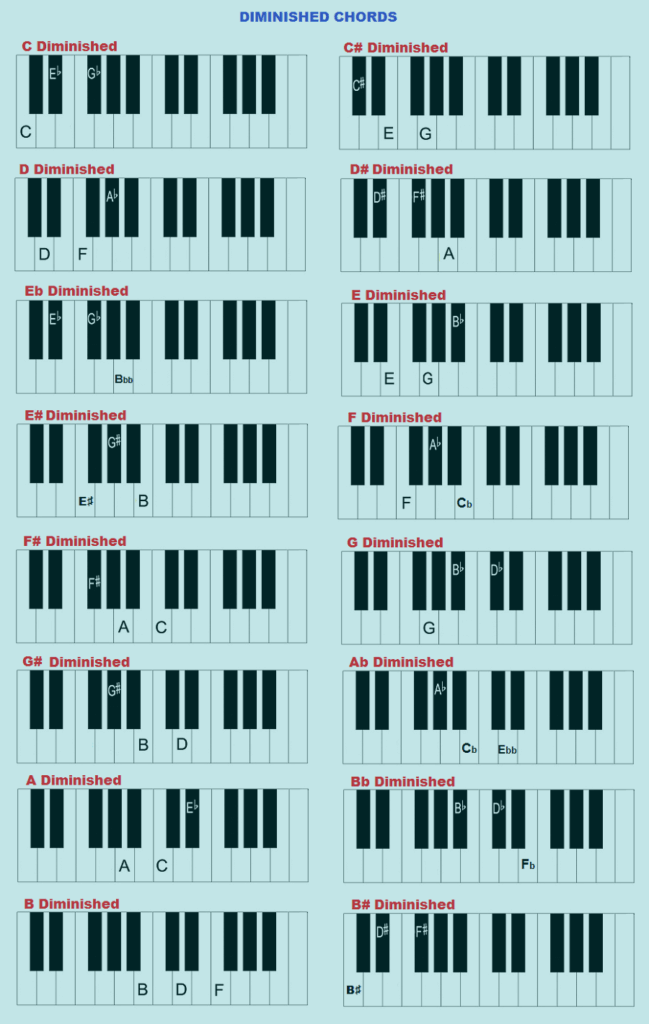
Here is a reference of Diminished Triads on all 12 Keys:
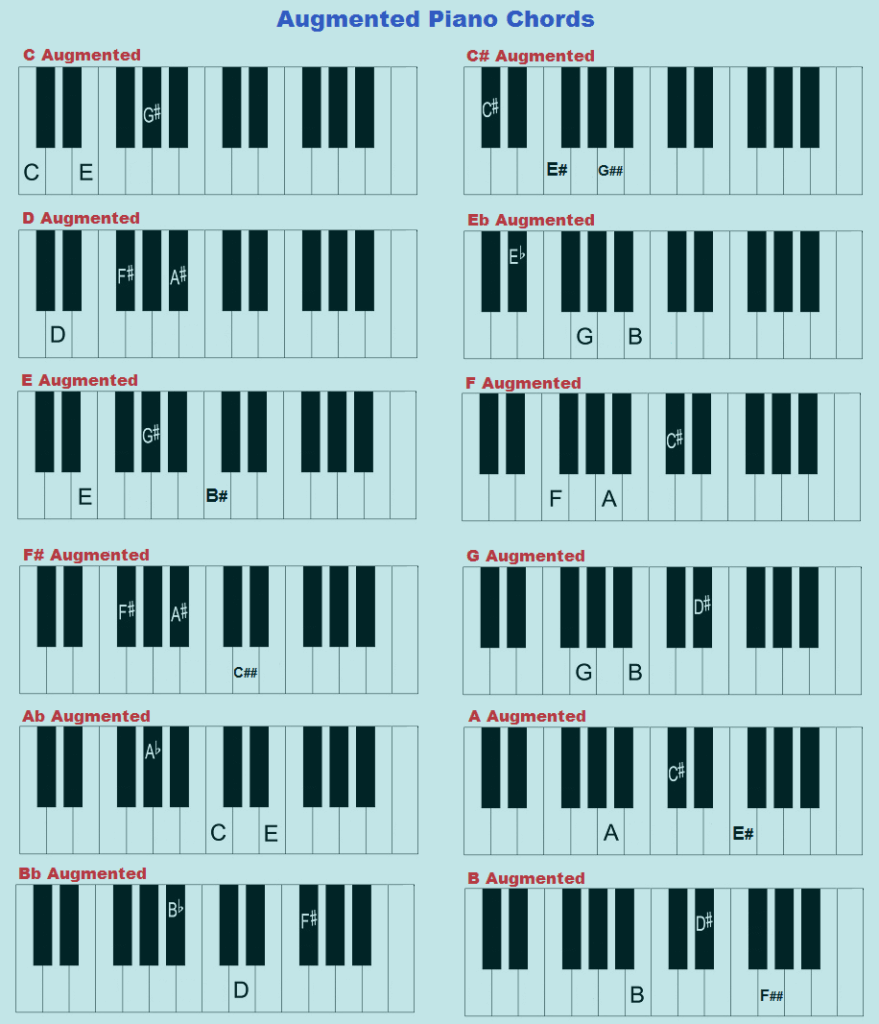
Here is a reference of Augmented Triads on all 12 Keys:
As an exercise please experiment random diminished chords (7 chord) and resolve to the “1 chord” in various keys.
Whooooosh!!! I understand this very well now
Glad it helps
Thanks my namesake for doing this blog for learners like us. may God continue to give you wisdom and grace to do more
Thank you for your prayers! God bless